


Companies still relying on manual or unspecialised tagging face avoidable risk. Errors are more likely to be scrutinised because ESEF reports are publicly available, and the filing window is tight, with ESEF reports required to be published and submitted within four months of the financial year end.
How ARKK tags your ESEF reports
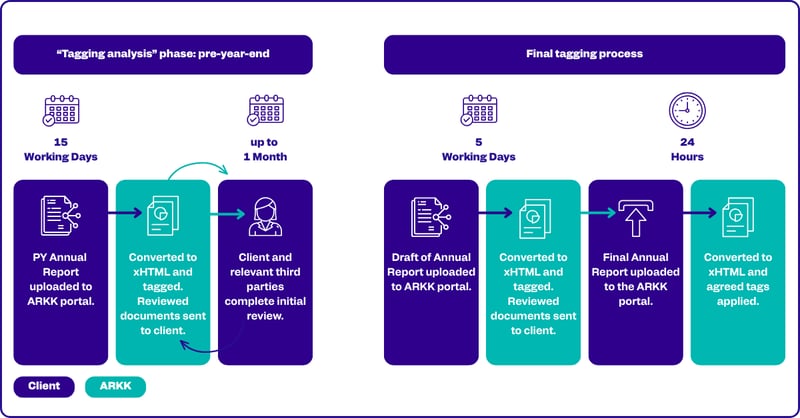
ARKK's UK-based team, tagging since 2009, applies the taxonomies set by ESMA to produce accurate, submission-ready xHTML files from your consolidated IFRS financial statements. Tagging begins before year-end using the prior year's format, so once your final annual report is ready, we apply the agreed tags and turn it around in as little as 24 hours (up to 5 working days for larger reports).

Save time
Save time
Tagging is handled by our expert team during your busiest reporting period, cutting the workload on internal finance teams.
Ensure accuracy
Ensure accuracy
Every report is tagged and reviewed by our experts against ESMA's guidance, since ESEF reports are publicly scrutinised.
Mitigate risk
Mitigate risk
Over 15 years of specialist tagging experience and a proven process reduce the risk of validation errors in a public filing.
Gain expertise
Gain expertise
A dedicated team applies more than 2 million tags to over 6,000 accounts annually, across ESEF and other tagging mandates.
Stay compliant
Stay compliant
Support built in for the four-month post-year-end deadline, with capacity managed around your busiest filing periods.
Plan ahead
Plan ahead
Tagging starts before your year-end using last year's format, so most of the work is already done once your final report is ready.

The information that came back from ARKK was so clear and transparent.
Kreeson Thatiha, Head of Finance and Client Money, eToro
I was continually reassured of ARKK's technology and their commitment to customer service.
Darryl Alford, Finance Manager, DPD
ARKK were prepared to be more flexible with how we worked and how we were set up.
Alistair McClelland, Head of Tax, The University of Edinburgh

Simply outstanding service and a real pleasure to work with.
Chris Parsons, Production Director, Radley Yeldar

ARKK are extremely responsive and supportive partners.
Janette Moriarty, Group Financial Reporting Director, Kerry Group
ARKK are invaluable to us… I wouldn't consider another project without them.
Valentin Ramousse, Head of International Business Development & Partner, Emperor Works
The speed and accuracy of implementation was incredible.
Akash Kalaiya, EMEA Tax Manager, Universal Weather and Aviation

+ What is ESEF?
ESEF (European Single Electronic Format) is a mandate requiring main market-listed companies in Europe to publish annual financial statements in machine-readable xHTML format. Consolidated IFRS financial statements must also be digitally tagged using the taxonomies set by ESMA. Reports must be published and submitted to the relevant regulator within four months of the financial year end.
+ How does ARKK handle ESEF reports?
ARKK's expert team applies ESMA-recognised taxonomies and block tagging to your consolidated IFRS financial statements, producing a machine-readable xHTML file that mirrors the original report to the human eye. The team reviews and tests each file before it's finalised, since ESEF reports are published publicly and open to scrutiny.
+ How long does ESEF tagging take?
Turnaround depends on the complexity of the report and the volume of block tagging required, since ESEF mandates tagging of policies and notes alongside primary statements. ARKK's team manages capacity around clients' busiest reporting periods, including completing large volumes of conversions during peak filing months.
+ Does ESEF tagging apply to non-consolidated financial statements?
No. Non-consolidated financial statements require the xHTML file format but not digital tagging. Only consolidated IFRS financial statements require ESMA-recognised taxonomies to be applied across the primary statements and notes.
+ How is data secured during the ESEF tagging process?
ARKK is ISO 27001 certified, the internationally recognised standard for information security management, and uses XBRL-certified tagging software with no limitations on tagging multiple layers of information. Files are managed through a secure process throughout production and review.
