


Save time
Save time
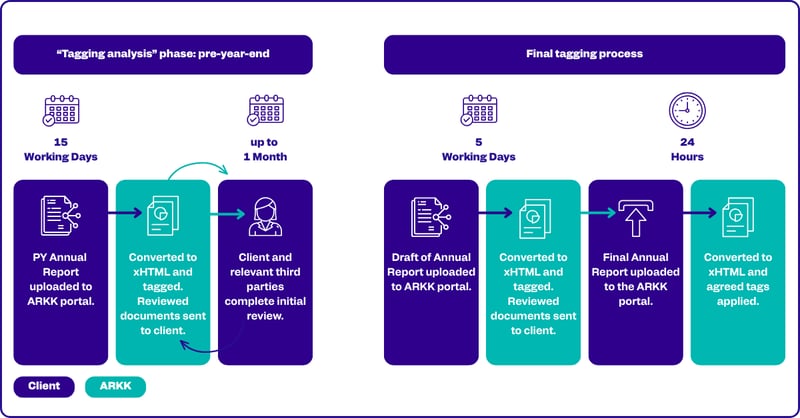
Tagging is handled by our expert team, with turnaround available in as little as 24 hours, cutting manual workload during filing season.

Ensure accuracy
Ensure accuracy
Reports are tagged and thoroughly tested against your specific framework, whether that's ESRS, ISSB, or SECR, before they go anywhere near submission.

Mitigate risk
Mitigate risk
Our ISO27001-certified systems keep every file secure and traceable, however public your final report becomes.

Gain confidence
Gain confidence
Our expert team applies over 2 million tags to more than 6,000 accounts every year, so the expertise is already in place.

Stay compliant
Stay compliant
As ESG mandates broaden and shift, we track the changes so your tagging never falls out of step with current requirements.

Get support
Get support
Reach our specialists for guidance whenever you need it, plus access to benchmarking tools to see how you measure up against peers.

Filing on behalf of clients?
ARKK has numerous agreements already in place with accountancy practices and other advisory firms. Our partner network allows you to combine advisory expertise alongside tagging experience, helping you service your clients at scale. Our team stays on top of evolving ESG standards, so your reports remain compliant as new requirements come into force.


The information that came back from ARKK was so clear and transparent.
Kreeson Thatiha, Head of Finance and Client Money, eToro

I was continually reassured of ARKK's technology and their commitment to customer service.
Darryl Alford, Finance Manager, DPD

ARKK were prepared to be more flexible with how we worked and how we were set up.
Alistair McClelland, Head of Tax, The University of Edinburgh

Simply outstanding service and a real pleasure to work with.
Chris Parsons, Production Director, Radley Yeldar

ARKK are extremely responsive and supportive partners.
Janette Moriarty, Group Financial Reporting Director, Kerry Group
ARKK are invaluable to us… I wouldn't consider another project without them.
Valentin Ramousse, Head of International Business Development & Partner, Emperor Works
The speed and accuracy of implementation was incredible.
Akash Kalaiya, EMEA Tax Manager, Universal Weather and Aviation