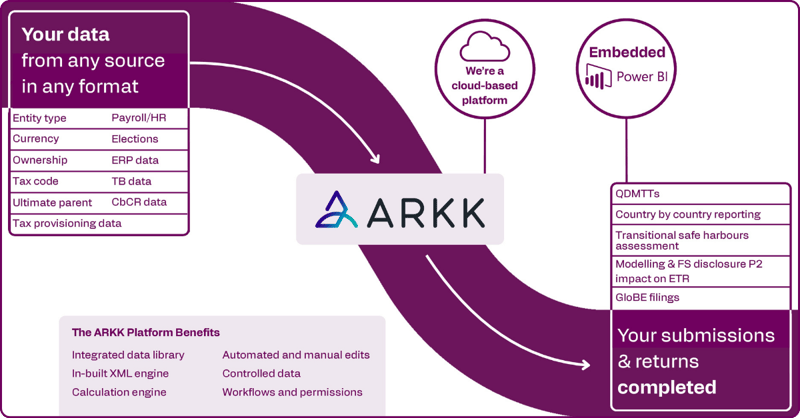

ARKK automates the complete Pillar Two compliance process for multinational groups, consolidating data across jurisdictions, running GloBE (Global Anti-Base Erosion) and QDMTT (Qualified Domestic Minimum Top-up Tax) calculations, and filing submission-ready returns directly with local tax authorities.
Yet for many groups, the current reality remains fragile: spreadsheet-driven processes and control gaps that create audit risk and personal accountability concerns. As regulatory scrutiny intensifies, the cost of ungoverned processes multiplies across top-up tax exposure, audit findings, and operational friction. ARKK removes that risk.
The complete Pillar Two process in four steps
From data aggregation to regulator submission, the ARKK Automation Platform handles every stage.
Aggregate
Centralise all Pillar Two data across jurisdictions, entities and systems into a single, governed data foundation.
Calculate
A fully integrated calculation engine delivering control and consistency across every entity and period.
File
Submission-ready returns filed directly with local tax authorities via API, using the regulator-recognised Platform.
Govern
Enterprise-grade governance with full accountability at every stage of the Pillar Two lifecycle.
How the ARKK Automation Platform works
The Platform is designed to be modular, so whether you need the full Pillar Two process automated or just the final XML conversion, you can implement what you need and be operational in weeks.

The ARKK Automation Platform in action
Save time
Save time
The complete Pillar Two process automated, with a built-in XML engine for direct regulator submission.
Maximise value
Maximise value
Source-agnostic, cloud-based SaaS with unlimited users, enabling data reuse across multiple reporting needs.
Mitigate risk
Mitigate risk
ISO27001-certified, with customisable workflows, team roles, with built-in validations and a full audit trail.
Gain visibility
Gain visibility
Embedded Power BI delivers real-time, board-ready reporting with a single source of truth for all data.
Stay compliant
Stay compliant
Built-in Generative AI retrieves OECD guidelines within the platform.
Plan ahead
Plan ahead
Scale with your business through forecasting across acquisitions, new jurisdictions and ETR thresholds.

The information that came back from ARKK was so clear and transparent.
Kreeson Thatiha, Head of Finance and Client Money, eToro

I was continually reassured of ARKK's technology and their commitment to customer service.
Darryl Alford, Finance Manager, DPD

ARKK were prepared to be more flexible with how we worked and how we were set up.
Alistair McClelland, Head of Tax, The University of Edinburgh

Simply outstanding service and a real pleasure to work with.
Chris Parsons, Production Director, Radley Yeldar

ARKK are extremely responsive and supportive partners.
Janette Moriarty, Group Financial Reporting Director, Kerry Group
ARKK are invaluable to us… I wouldn't consider another project without them.
Valentin Ramousse, Head of International Business Development & Partner, Emperor Works

The speed and accuracy of implementation was incredible.
Akash Kalaiya, EMEA Tax Manager, Universal Weather and Aviation

+ What is Pillar Two?
Pillar Two is a global minimum tax framework introduced by the OECD, requiring large multinational groups with annual revenues exceeding €750 million to pay a minimum effective tax rate of 15% in every jurisdiction they operate in. Where a group's effective tax rate falls below that threshold in a given jurisdiction, a top-up tax applies. Compliance requires groups to aggregate entity-level financial data, calculate GloBE and QDMTT liabilities, and file returns with local tax authorities, a process that is highly complex to manage manually across multiple jurisdictions.
+ How does ARKK automate Pillar Two compliance?
The ARKK Automation Platform delivers the complete Pillar Two process in four steps: aggregating data from any source system into a single governed environment, running GloBE and QDMTT calculations through a fully integrated calculation engine, filing submission-ready XML returns directly with local tax authorities via API, and providing enterprise-grade governance and a full audit trail across every stage. The platform is modular, so groups can implement the full end-to-end process or simply the final XML conversion.
+ How long does it take to implement ARKK's Pillar Two solution?
The ARKK Automation Platform is designed to be operational in weeks, not months. The modular structure means implementation scope is defined by what you need, so groups that require only the XML filing component can go live faster than those implementing the full end-to-end process. Your dedicated Customer Success team provides guidance throughout onboarding and extended support around reporting deadlines.
+ Does ARKK integrate with existing ERP and data systems?
Yes. The ARKK platform is source-agnostic, meaning it connects to data from any system, whether that is an ERP, consolidation tool, or spreadsheet-based process. Data is ingested once and reused across multiple reporting processes without limits on volume or complexity, removing the need to re-extract or reformat data for different compliance obligations.
+ How is data secured on the ARKK platform?
ARKK software is ISO 27001 certified, the internationally recognised standard for information security management. The Platform includes customisable workflows, defined team roles, and built-in validations, ensuring that access controls and data integrity are maintained throughout the Pillar Two lifecycle.
+ Is ARKK recognised by regulators?
Yes. ARKK is a regulator-recognised platform (including HMRC), enabling direct XML filing with local tax authorities via API. This means submission-ready returns are filed directly through the platform rather than requiring manual upload or third-party intermediaries.
+ What are the risks of managing Pillar Two manually?
Many multinational groups still manage Pillar Two compliance through spreadsheet-driven processes with scattered ownership and limited controls. As regulatory scrutiny intensifies, these approaches create material risk: calculation errors expose groups to top-up tax liabilities, inadequate documentation triggers audit findings, and individuals responsible for sign-off face personal accountability concerns. Manual processes also struggle to scale as the number of jurisdictions, entities, and reporting periods grows.