


ARKK's regulatory reporting portal takes your raw charges and transaction data and shapes it into a compliant Instant Payments Regulation return. The latest EBA taxonomy sits under the hood, validations run as you go, and the Excel-based templates plug straight into the workbooks your team already lives in. Roll-forward carries your figures from one cycle to the next, so you are not rebuilding the return from scratch each year.
For payment service providers, doing this by hand is where things slip. Charges data is spread across systems, rejected-transaction numbers are awkward to reconcile, and a single fixed annual deadline to your competent authority turns a busy period into a risky one.
How ARKK simplifies Instant Payments Reporting
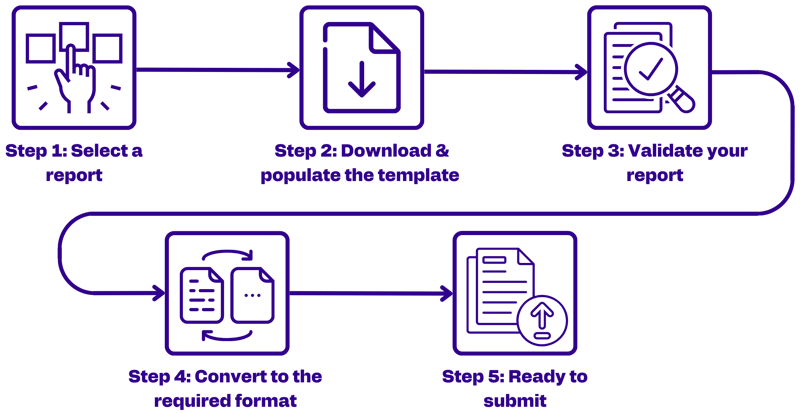
The ARKK portal moves your IPR return from selection to submission in five straightforward steps. Choose the report you need, download and populate the template with your charges and transaction data, validate it against the relevant schema, convert it to the required format, and it is ready to submit to your competent authority.

Save time
Save time
Bring charges, payment account and rejected-transaction data together once, then let roll-forward carry it forward every reporting cycle.
Maximise value
Maximise value
Run your IPR return alongside CRD IV, AIFMD and Solvency II, drawing on a single shared reporting dataset.
Eliminate errors
Eliminate errors
Built-in EBA technical and business checks surface incomplete or mismatched charges data before it reaches your competent authority.
Gain security
Gain security
Prepare and hold every return in an ISO 27001 certified portal, with role-based access and a full audit trail.
Stay compliant
Stay compliant
Taxonomy, datapoint model and validation-rule changes are managed for you, keeping each return aligned with current EBA rules.
Plan ahead
Plan ahead
Get clear sight of charges, accounts and rejected transactions, so gaps surface in good time, not at the deadline.

The information that came back from ARKK was so clear and transparent.
Kreeson Thatiha, Head of Finance and Client Money, eToro

I was continually reassured of ARKK's technology and their commitment to customer service.
Darryl Alford, Finance Manager, DPD

ARKK were prepared to be more flexible with how we worked and how we were set up.
Alistair McClelland, Head of Tax, The University of Edinburgh

Simply outstanding service and a real pleasure to work with.
Chris Parsons, Production Director, Radley Yeldar

ARKK are extremely responsive and supportive partners.
Janette Moriarty, Group Financial Reporting Director, Kerry Group

ARKK are invaluable to us… I wouldn't consider another project without them.
Valentin Ramousse, Head of International Business Development & Partner, Emperor Works

The speed and accuracy of implementation was incredible.
Akash Kalaiya, EMEA Tax Manager, Universal Weather and Aviation

+ What is Instant Payments reporting?
The Instant Payments Regulation (EU 2024/886) requires payment service providers to send standardised annual reports to their National Competent Authority, covering charges on credit transfers and payment accounts, plus the share of transactions rejected because of targeted financial restrictive measures.
+ How does ARKK support Instant Payments Reporting compliance?
ARKK gathers your charges, payment account and rejected-transaction data, applies the EBA taxonomy and validation rules, and produces a submission-ready return that goes from your workbooks to your competent authority in a few clear steps.
+ How long does it take to implement an Instant Payments Reporting solution?
+ Does ARKK integrate with existing data systems?
Yes. The Excel-based templates connect to your existing workbooks and source data, so you can bring charges and transaction figures together without rekeying them into a new system.
+ How is data secured on the ARKK platform?
The ARKK portal is ISO 27001 certified, with role-based access, controls and a full audit trail across every return, so your data stays protected at each stage.
+ What are the risks of managing Instant Payments reporting manually?
Charges and transaction data usually sit across separate systems, so pulling it together by hand is slow and error-prone. Mismatched figures, miscategorised charges and skipped validations can lead to a rejected return right when time is tight.
